

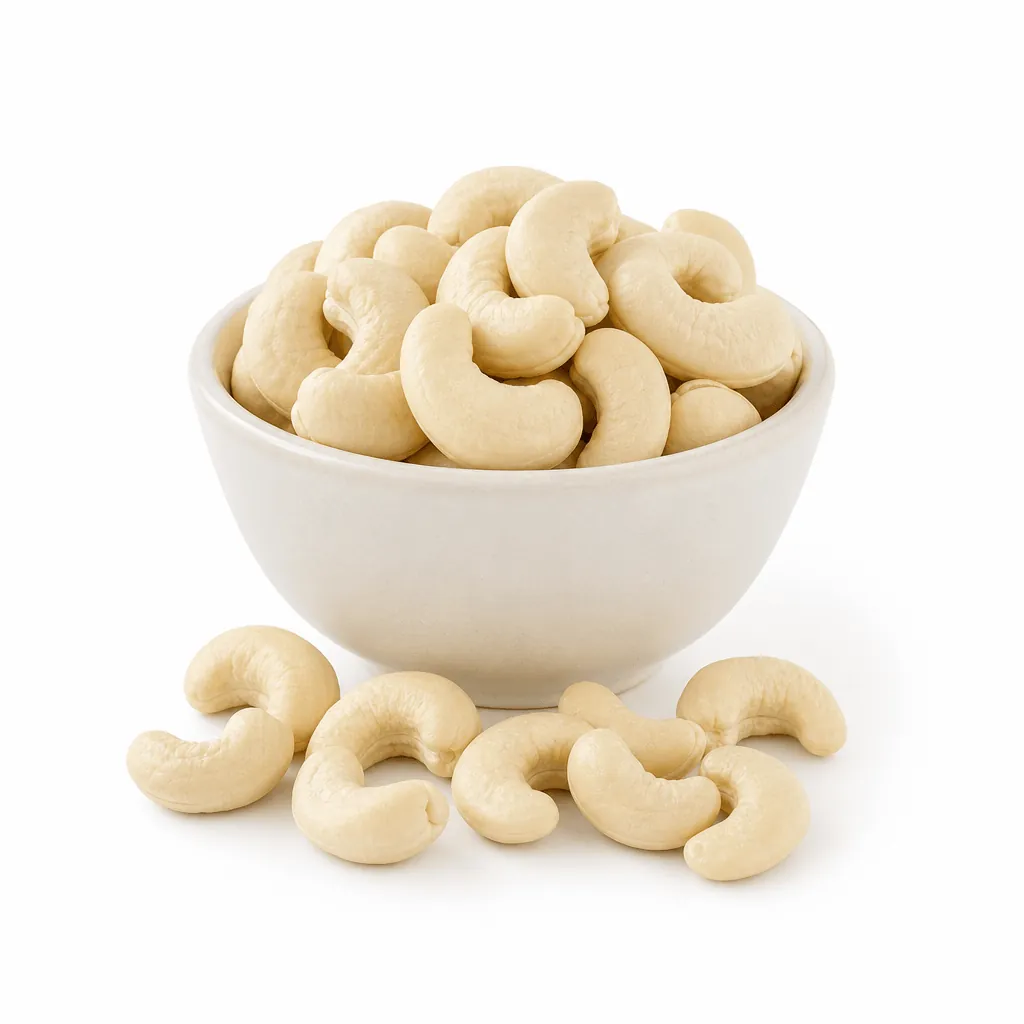
A W320 label is not enough to approve a cashew kernel order. Agree the form, colour or quality class, count range, defect definitions, tolerances and measurement method before signing. Record the offered lot and the evidence needed to check it. A percentage without a denominator or method leaves the acceptance decision unresolved.
Use this checklist to prepare the initial specification. It keeps the buyer's agreed requirements separate from later inspection results. The blank worksheet has no default tolerance values: the buyer and supplier must settle those fields for the intended use.
What does W320 leave undecided?
Afri Exports' documented W320 benchmark is 300–320 kernels per pound. That count range describes size; it does not by itself answer how much broken material is permitted, which colour defects count, or which inspection report will support acceptance. Write each requirement separately rather than treating the grade name as a completed specification.
Start with the application. A buyer needing visible whole kernels has a different form requirement from a buyer using pieces. State the required form and quality class before discussing allowances. Keep size variation, broken material, lower-grade defects and serious damage in separate rows so one allowance cannot silently absorb another.
Which reference defines whole kernels, butts and splits?
The Association of Food Industries' Specifications for Cashew Kernels, adopted September 2023, is an industry reference buyers can name in their agreement. Under its definition, a whole retains the characteristic kernel shape and has lost no more than one eighth of the kernel. A butt is a crosswise break with the two halves still attached; a split is a lengthwise half. Consult the full reference for the exact dimensional qualifications.
The distinction affects inspection. A small chip does not automatically make a kernel broken under the named whole definition. Conversely, a lengthwise half should not be counted as a small whole merely because its weight falls within a convenient range. Record the definition used to classify the material before calculating the percentage.
AFI is an attributed technical reference here. This article does not establish that Afri Exports or an offered lot is AFI-certified, or that every AFI provision is a universal legal requirement. Name the version and sections the contract adopts, along with any agreed departures. Do not describe a modified specification simply as “AFI compliant”.
What belongs in each specification row?
Give each row one measurable question. For example, the broken-material row asks how much material fails the adopted whole-kernel definition. A lower-size row asks how much belongs to a smaller size grade. Those are different checks even when both are reported as percentages.
- Parameter and precise definition, including the reference section and version.
- Required form or quality class and buyer-agreed acceptance criterion.
- Unit and denominator: mass of affected material over examined mass, or another expressly agreed basis.
- Sampling plan, examined quantity, inspection stage and analytical method reference.
- Offered lot, sample identity, sampling date and report reference.
- Measured result, evidence status, unresolved question, responsible person and decision date.
Keep serious damage distinct from ordinary appearance defects. AFI separates serious damage, including visible mould, rancidity and certain contamination, from lower-grade appearance defects. Its tables contain category limits and total limits. If adopting them, identify the relevant grade column and category rather than copying one total percentage into every row. Use the named method's scoring rules to avoid counting the same kernel repeatedly.
Is the percentage by weight or by count?
Write the denominator into the specification and the report. AFI's grade method calculates breakage and grade defects by weight; its size count is a separate determination. “Broken: 4%” does not tell the reader whether the inspector weighed fragments or counted items. Those approaches cannot be treated as interchangeable.
For a mass-based row, record affected mass, total examined mass and the resulting percentage. For a count-based determination, record the counted category and examined count or specified sample basis. Do not change units to make unlike reports appear comparable. Ask for clarification when the reporting basis is missing.
Which sample and inspection stage does the result describe?
A report must connect the examined sample to the offered commercial lot. Record who sampled, when, which packages were represented and the sampling plan. Then identify the inspection stage, such as the agreed pre-loading check. A loose sample with no recorded lot connection cannot establish conformity of the offered shipment.
Keep sampling and analysis references separate. The first determines how material is collected from the lot; the second determines how the collected material is classified and measured. If adopting AFI's plan, confirm how the specified pack configuration is handled. Do not assume that an example based on another carton weight applies unchanged to the contracted packing.
Worked hypothetical decision: a missing denominator
This is an illustration of a document decision, not a real lot, inspection or customer account. An offer says W320 and a draft report field says “broken percentage”, but the field does not specify mass or count. The buyer needs a weight-based criterion under the chosen reference.
The worksheet records the requested basis as percentage by weight, leaves the measured result blank and marks the row “clarification required”. The next action is to confirm the sampling and analytical method and obtain a report on that basis. The decision stays pending under the buyer's procedure. No pass or fail is inferred from the grade label, and no tolerance is invented to fill the gap.
How do you close the specification before ordering?
Review every unresolved row with the supplier. Record the final specification revision, accepted departures, approval scope and buyer approver. Keep the agreed criterion in its own column after results arrive. Overwriting the criterion with a measured result removes the comparison the worksheet was meant to preserve.
If the proposed form later changes, use a separate substitution decision. This worksheet establishes the initial agreement; it does not approve a later replacement grade or establish equivalent performance in the buyer's process.
What should you send with a cashew enquiry?
Send the intended use, grade and form, quantity, packing, destination and completed requirement columns. Include requested tests and the proposed trade term with its named place. Ask which offered-lot evidence is available and which requirements remain to be confirmed.
Afri Exports documents kernel moisture below 5%, a kernel order basis of one 20ft container at approximately 12.5 MT, and 10 kg vacuum tins in cartons. These are the commercial starting points; they do not fill in the buyer's defect tolerances or confirm current stock. The supplier page is the place to discuss the specification and order configuration.
Related reading

Leave a Comment
Your email address will not be published.