

At a glance
- Optical colour sorters photograph every kernel in free fall with high-speed cameras and use timed jets of compressed air to eject scorched, spotted or foreign material within milliseconds.
- Machines sold as AI sorters run image classifiers trained on kernel photographs, judging colour, shape and surface texture together — better on subtle defects than fixed colour thresholds.
- Sorting enforces the colour and defect side of a grade spec (the whiteness of a W320 lot, the separation of amber kernels into SW grades); kernel counts per pound come from mechanical sizing, not colour sorting.
- Machines do not replace graders: style and wholeness judgment, borderline colour calls and final pre-pack QC remain human work.
- A sorter cannot measure moisture, aflatoxin or taste — those need calibrated meters, laboratory testing and cutting checks.
- The buyer's question set: where sorting sits in the line, what happens to rejects, what manual QC follows, and what per-lot defect data the supplier can show.
Optical colour sorters — increasingly marketed as AI sorters — are machines that photograph every kernel passing through a processing line and use precisely timed jets of compressed air to eject anything the wrong colour: scorched kernels, spotted or blemished pieces, shell fragments and foreign material. Most modern cashew plants run at least one; the better ones run several, at different points in the line. For a buyer, the machine itself matters less than what it means for the carton you receive — and what it still cannot do.
How does an optical colour sorter actually work?
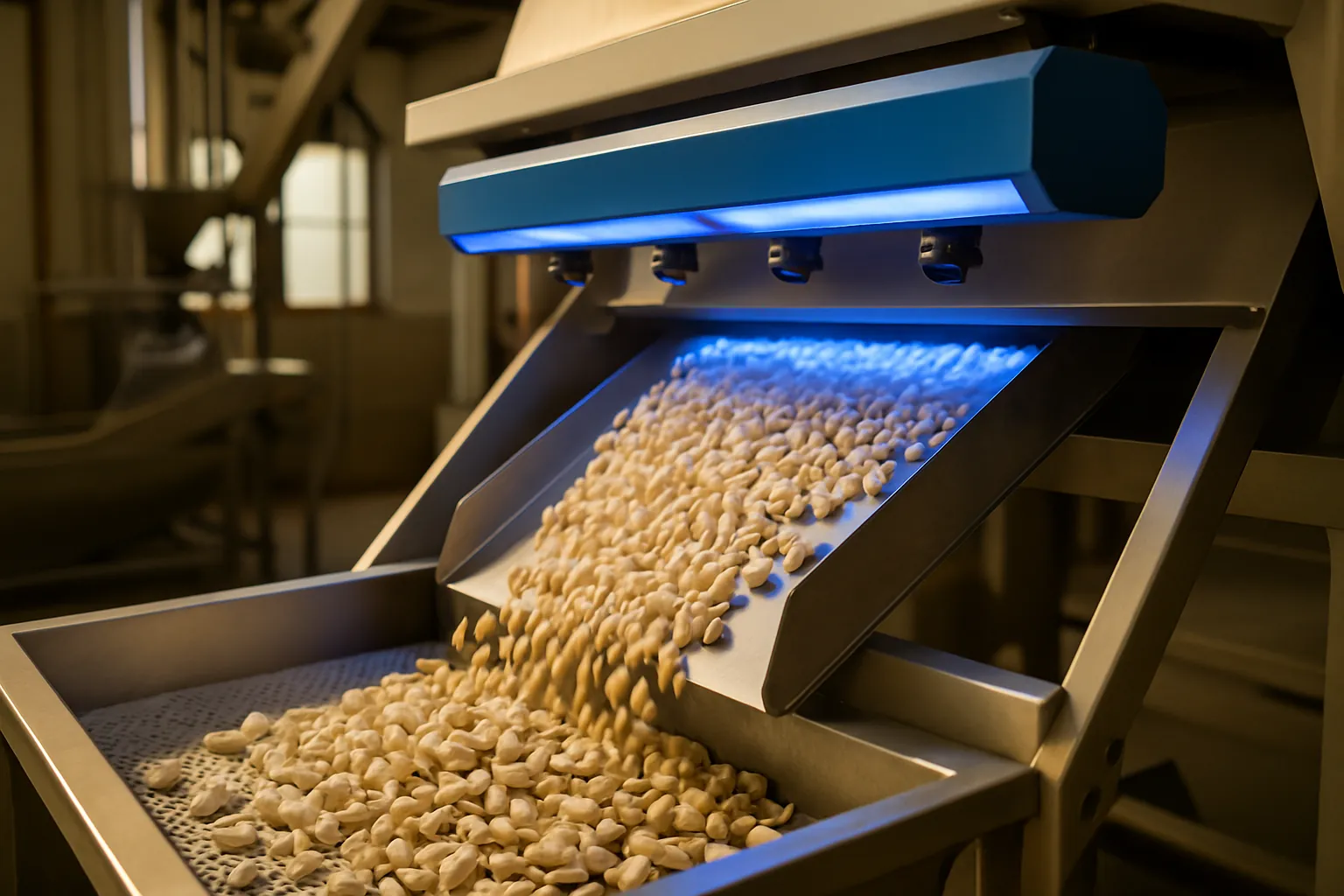
A colour sorter inspects kernels in free fall and rejects defective ones with air jets, processing tons per hour. The principle has not changed since Sortex-type machines entered the nut trade decades ago — what has changed is the software behind the cameras. The line runs in five stages:
- Feed — kernels flow from a hopper across a vibrating tray that spreads them into a single, even layer.
- Free fall — the layer slides down an inclined chute and launches into open air, presenting every kernel to the cameras.
- Imaging — high-speed cameras, usually paired front and back under controlled LED lighting, photograph each kernel in flight.
- Classification — the software judges each kernel against its accept criteria in a few milliseconds.
- Ejection — a bank of compressed-air nozzles fires a timed jet at each rejected kernel, deflecting it into the reject stream. Many plants re-pass that stream to recover good kernels knocked out by an over-cautious first pass.
What makes the newer machines 'AI'?
Older sorters compare each pixel against fixed colour thresholds — anything darker than the set point gets the air jet. The machines now sold as AI sorters instead run image-classification models trained on large libraries of kernel photographs, which lets them judge colour, shape and surface texture together rather than colour alone. The practical gains are on subtle defects: faint scorch marks, small testa flecks, immature or shrivelled kernels that pass a simple colour check but fail a human eye. Trained models also cut the false-reject rate — every sound kernel blown into the reject stream is yield given away.
The label is worth reading plainly, though: 'AI' on a sorting line means a trained image classifier doing one narrow job very well — not a machine that understands cashews.
What do sorters catch — and what still needs human graders?
A well-set sorter removes colour defects and foreign material at a speed no sorting table can match. What it cannot replicate is judgment — the calls that decide how a lot is presented and whether it truly meets its specification. The machine reliably removes:
- Scorched and amber kernels — separated into the SW stream as saleable product, not discarded.
- Spotted, blemished and mould-marked kernels.
- Residual testa (skin) flecks left after peeling.
- Shell fragments, stones and other foreign material.
- Insect-damaged kernels showing surface discolouration.
Human graders still own the rest:
- Style and wholeness judgment — whether a kernel with a hairline seam crack sells as a whole or a split is a grader's call, not a camera's.
- Borderline colour decisions where white ends and scorched begins, which set how much of a lot earns the white-whole price.
- Kernel counts per pound, verified against the contracted grade.
- Final pre-pack QC — the last look at every lot before tins are sealed.
- Sample drawing and cross-checks against the contract specification.
How does machine sorting relate to the grade specs you buy?
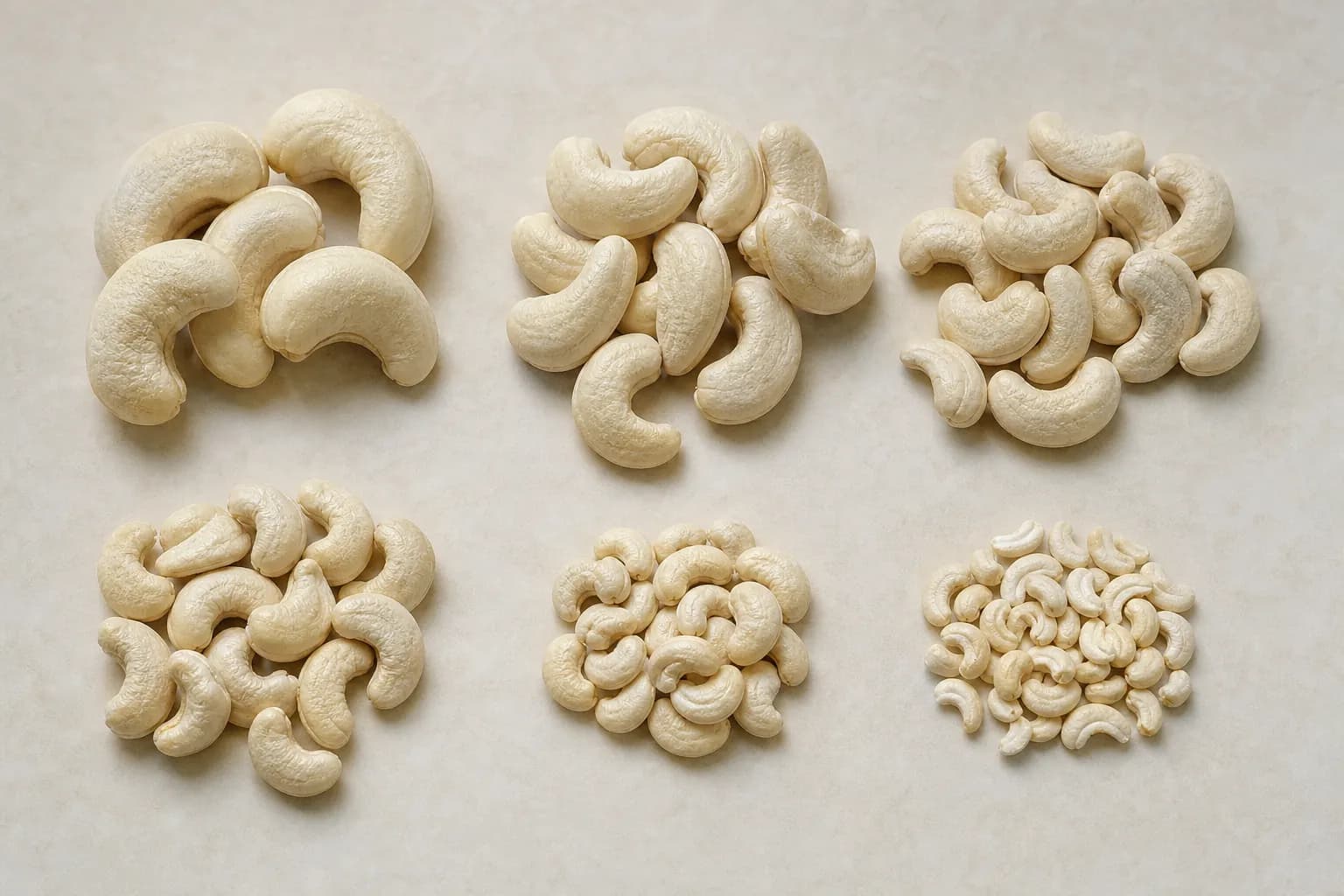
A cashew grade specification has three dimensions: size (the kernel count per pound), colour, and defect tolerances. Colour sorting enforces the second and third; the first is set by mechanical sizing before the sorter ever sees a kernel. So when a W320 spec calls for uniformly white kernels within defined tolerances for scorched and spotted pieces, the sorting line is what makes that deliverable at container scale — and the SW grades exist precisely because sorters separate sound amber kernels into their own stream instead of wasting them. The defect counts your QC team runs on arrival are, in effect, an audit of how well the supplier's sorting and grading worked.
What should you ask a supplier about their sorting line?
You do not need to audit camera specifications. Five questions reveal most of what matters:
- Where does colour sorting sit in your line — once after peeling, or again before packing?
- What happens to rejected kernels — re-sorted, downgraded into SW and pieces, or discarded?
- How are borderline white-versus-scorched kernels decided, and by whom?
- What manual grading and final QC happens after the machines?
- Can you share per-lot defect counts from final inspection with each shipment?
A supplier who can answer these in plain terms is running a controlled process. Vague talk of 'fully automated quality' usually means the opposite — automation with no one checking what it misses.
What can a sorter not tell you?
A colour sorter sees the surface of the kernel and nothing else. Three of the things buyers care most about are invisible to it:
- Moisture — measured with calibrated meters at intake, during drying and at bagging; nothing optical about it.
- Aflatoxin — a chemical contamination no camera can see; only laboratory testing of representative samples answers it.
- Taste and rancidity — judged by cutting tests and sensory checks, not imaging.
That is why a serious quality programme treats sorting as one control in a chain, not the chain itself: moisture management from harvest, out-turn testing at intake, sorting and grading in the plant, and laboratory tests before despatch. Our aflatoxin guide covers the chemistry side of that chain; the out-turn (KOR) guide explains the intake tests.
“The camera never gets tired, and the grader never stops thinking. A line that respects the difference produces cartons neither could deliver alone.”
- Asha Ngonyani, Quality Manager
Our own programme works the way the best of the trade does: sortex-type optical cleaning where it adds control, backed by trained sorters who grade every lot by size, colour and count — so the grade you order holds true from first carton to last. To see what that discipline produces, request a sample against your specification and run your own counts.
Related reading
Leave a Comment
Your email address will not be published.