

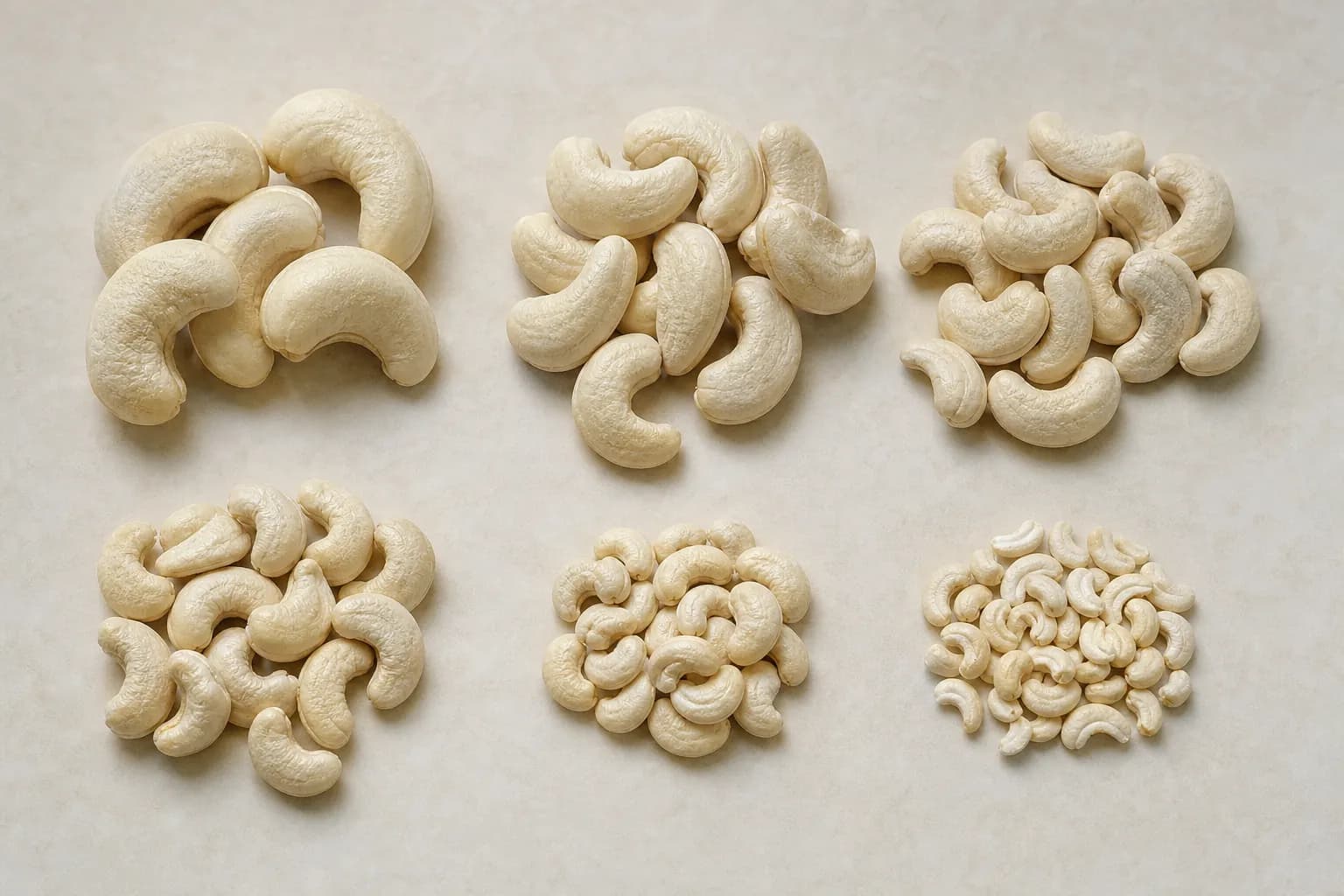
At a glance
- 1. Enquiry — grade, quantity, destination port, Incoterm and timing, in the first email.
- 2. Specification — count per pound, moisture, defect tolerances and packing, agreed in writing.
- 3. Sample — drawn across the lot, sealed and lot-numbered, approved before a container is booked.
- 4. Quotation and proforma invoice — the PI is what you pay against; check every line.
- 5. Contract — Incoterm, payment terms, inspection rights, tolerances and the remedy if counts fail.
- 6. Payment — a Letter of Credit at sight, or a deposit with the balance against documents.
- 7. Production and lot allocation — numbered lots, each laboratory tested before despatch.
- 8. Pre-shipment inspection — yours or a third party's, at your cost, before the container is sealed.
- 9. Shipping and documents — phytosanitary certificate, certificate of origin, packing list, B/L, COA.
- 10. Arrival and repeat orders — verify while the container is open; the second order runs on the first one's paperwork.
Most buyers settle the grade long before they work out how the buying itself runs. What stalls a first container is the sequence around it — who sends what, in which order, and which document you are actually paying against. This is that sequence, from first email to second order.
It pairs with our guide to vetting a cashew exporter, which answers a different question: who to trust. That one runs before you choose a supplier; this one runs after. Work those nine checks first, because none of the steps below will protect you from a counterparty who should never have been contracted.
Step 1 — What should I put in my first enquiry?
The difference between a quote in one reply and a fortnight of back-and-forth is about seven lines of detail:
- Grade and form — W180, W240, W320, SW, splits, pieces; or raw cashew nuts by out-turn.
- Quantity — what you want to start with, and whether it is a trial or a programme.
- Destination port, not just the country. Freight and documentation follow from it.
- Incoterm — FOB, CFR or CIF, which decides who books the vessel and where risk passes.
- Timing — the week you need the goods to sail, or the week you need them to land.
- End use — retail packing, bakery, roasting or butter. It often changes which grade we recommend.
- Who you are — company name, registered address, and the person who will sign.
Pricing follows from that, not the other way round: we quote against your specification and your destination, because the same grade prices differently into the Gulf, into Europe and into East Africa. An enquiry reading 'send your best price for cashews' comes back as this list of questions, and two working days are gone.
If you are unsure how much to start with, size the order before you ask for a price — our cashew MOQ guide sets out what is workable at each order size and what improves as volume grows.
Step 2 — How do we agree the specification?
The specification sheet is the spine of everything that follows: the sample is drawn against it, the contract annexes it, the inspector measures it and you check the arrival against it. Pin these:
- Grade and count per pound, with a tolerance band rather than a single number.
- Maximum moisture — typically 5 per cent for export kernels, 8 to 10 per cent for raw nuts.
- Defect tolerances for broken, scorched, spotted, foreign matter and infestation.
- Colour band, and whether scorched wholes may sit inside the white grade.
- Packing format — vacuum tin in carton and net weight per unit; woven polypropylene bags for raw nuts.
- Marking, labelling and palletisation for your market.
- The aflatoxin limit the lot is tested against, read from your destination market.
Two lines are worth arguing over. A count is a range rather than a constant, so the tolerance band decides what 'in spec' actually means. And aflatoxin limits vary by jurisdiction — testing to the wrong one is discovered at the border.
Step 3 — How do cashew samples work?
Order of operations first: your specification goes out, then the sample comes back. A sample sent before there is anything to judge it against is a marketing item. Samples run 250 g to 1 kg per grade, travel by courier in one to two weeks, and are usually free with the buyer paying freight — sealed, lot-numbered, with the certificate of analysis for that lot.
What to check the day it lands:
- The seal is intact and the lot number matches the one on the COA.
- Count it yourself — weigh out a pound and compare against the contracted count and tolerance.
- Colour in daylight, not under warm office lighting, against the agreed band.
- Broken, scorched and spotted kernels as a percentage, measured rather than eyeballed.
- Smell and taste for rancidity — it tells you about storage and handling.
- Moisture, if you have a meter, or through your own laboratory.
Then seal a counter-sample and keep it. Both sides holding an identical retained sample is what turns 'the container is not what we agreed' into a question with an answer. The step is not negotiable at any volume: approving a sample after the container is booked means you approved a container.
Step 4 — What should a proforma invoice contain?
Once the sample is approved, the quotation firms into a proforma invoice. The PI is not the contract, but it is what your bank opens an LC against and what your finance team pays from:
- Seller's registered name, address and bank details — all in the same name.
- Buyer's registered name and address, as they should appear on the shipping documents.
- Goods description naming grade, form, crop year and origin.
- Quantity, net and gross weight, and number of packages.
- Unit price, total, currency, and the Incoterm with its named port.
- Payment terms and schedule, stated as amounts and triggers.
- Shipment window, port of loading and port of discharge.
- PI number, issue date, and a validity date for the offer.
Reconcile it against the specification before acting on it. A PI whose grade, count or packing has drifted from the approved sample is either a clerical slip or the deal changing shape, and both cost less to fix now than at discharge.
Step 5 — What belongs in the contract?
The contract turns the specification and the PI into obligations. Beyond the commercial basics, four clauses do the real work:
- Incoterm with the named port and latest shipment date, so freight, insurance and risk are unambiguous.
- Payment terms — instrument, amounts, triggers, and the documents that release each tranche.
- Inspection rights — that you may appoint an inspector before loading, and that access will be given.
- Tolerances and their remedy — what happens if counts, moisture or defects fall outside the band.
That last clause is the one most first contracts leave out and the one everyone later wishes they had written. Agree the remedy while both sides are relaxed: a price allowance per point outside tolerance, replacement of affected lots, or a rejection threshold. Settle too whether quality is judged at shipment or at destination, and name the arbitration forum. None of it is adversarial — it is what lets a deviation be handled in a week rather than a quarter.
Step 6 — What payment terms are normal?
Two structures cover most of the trade. A Letter of Credit at sight, with the required documents defined in the LC text, is the more formal route and more common on larger contracts; it carries bank charges on both sides, which is why smaller first orders often skip it. The alternative is a deposit at contract with the balance against shipping documents, settled by telegraphic transfer.
A deposit is normal, not a warning sign: the exporter buys, processes, tests and packs before a container moves. What is not normal is full payment in advance, or payment to an account in a personal name. Terms are cautious on a first contract and soften as a shipment history builds.
Step 7 — What happens at origin once payment is opened?
This is the part buyers see least of, and where the goods are actually made. In our case it runs at Mtwara, in southern Tanzania, where we have sourced since 2010:
- Raw nuts are drawn from stored crop, with source districts and harvest window recorded.
- Processing runs under Tanzania Bureau of Standards certification — steaming, shelling, drying, peeling.
- Kernels are graded by size and colour, then checked against the contracted count.
- Moisture is measured, and kernels are vacuum-packed and cartoned to the contracted format.
- Each lot is numbered and a sample drawn from it for laboratory testing.
- The certificate of analysis for each lot is tied to that container's shipping documents.
Ask for the lot list when production finishes. Those numbers should reappear on the packing list, on the COA and in any inspection report, and full traceability back to the districts a lot came from is a reasonable thing to require.
Step 8 — Should I inspect before the container ships?
On a first container, yes. Send your own representative, appoint a third-party agency, or use an agent you already work with in-country. All three are at the buyer's cost, all three are routine, and no legitimate exporter objects.
A pre-shipment inspection should cover:
- Counts and defect percentages from randomly drawn cartons, not from a pallet chosen for you.
- Packing integrity — vacuum seals intact, cartons sound, net weights matching the packing list.
- Marking and labelling as contracted, including lot numbers on the cartons.
- Container condition before stuffing — clean, dry, odour-free, no previous-cargo residue.
- The seal number recorded at closing, to be checked against the bill of lading on arrival.
On a running programme most buyers step down to periodic inspection. The first one earns its cost by confirming that the spec sheet, the sample and the goods describe the same nut.
Step 9 — Which documents travel with the shipment?
The container moves on a documentation set, and the goods cannot be collected without it:
- Commercial invoice.
- Packing list, itemised with lot numbers and net weights.
- Certificate of origin.
- Phytosanitary certificate from the origin plant-health authority.
- Certificate of analysis for the shipped lots, with moisture and aflatoxin results.
- Bill of lading, with container and seal numbers.
- Marine insurance certificate, on CIF terms.
- Fumigation or weight certificates, where your market requires them.
Ask for drafts before originals are issued. Correcting a consignee name on a draft takes an email; correcting it afterwards means reissuing documents and, with a bill of lading, can hold the goods at the destination port. What then happens at the border — duties, food-safety checks, clearance — is a separate subject, and our guide to importing cashew nuts from Tanzania covers it properly.
Step 10 — What happens on arrival, and what changes next time?
Do the arrival check while the container is still open. Confirm the seal number against the bill of lading, then run counts and defect checks across cartons drawn from different parts of the load, compared against the retained sample rather than against memory. If something is out, raise it in writing the same day with photographs and lot numbers — that conversation is straightforward while the lot is intact, and much harder afterwards.
The second order is a shorter version of the first. The specification already exists, so the enquiry collapses to a volume, a port and a date. Sampling becomes a routine per-lot pre-shipment check rather than a full approval cycle. Terms usually improve with a settled shipment behind you. And allocation can be booked ahead against the new crop rather than bought from whatever is in store.
“A first container is slow because you are building the paperwork. Every order after that runs on it.”
- Daniel Mahenge, Logistics Coordinator
How long does the whole process take?
In a normal season, expect a quote within a business day or two of a complete enquiry, and a sample cycle of one to two weeks dominated by courier transit and your own testing. Contracting and opening payment usually takes a further week, faster on telegraphic transfer than on a Letter of Credit. First containers generally ship within 30 to 45 days of contract sign-off, depending on document timing and vessel schedules from Mtwara or Dar es Salaam. The commercial steps are quick; sampling and documentation set the pace.
Start the process
Related reading
- How to vet a cashew exporter- Nine checks to run before you choose a supplier
- How to import cashew nuts from Tanzania- Customs, food-safety limits and clearance detail
- Cashew wholesale MOQ explained- Sizing a first order without overcommitting
- Cashew kernel grades explained- The vocabulary your specification sheet needs
Related reading
Leave a Comment
Your email address will not be published.