
At a glance
- Registration — get the registered company name and number, and check the public registry.
- Certification — which standard, which issuer, what scope, what expiry; verify with the issuer.
- Per-lot lab report — a COA carrying your lot number, with moisture, aflatoxin B1 and total, and count or out-turn.
- Traceability — a real exporter names the districts and harvest window a lot came from.
- Sample before container — always, drawn across the lot, sealed and lot-numbered.
- Grade honesty — 'premium cashews' is not a grade; W180, W240, W320, SW, splits and pieces are.
- Payment terms — an LC at sight, or a 20 to 30 per cent deposit with the balance against documents. Full advance to a personal account is not.
- Documentation — invoice, packing list with lot numbers, certificate of origin, phytosanitary certificate, test reports, bill of lading.
- A real conversation — a call where spec questions get precise answers, and references you contact yourself.
Vetting a cashew exporter comes down to the nine checks above, and every one of them can be run before any money moves. Buyers who work through all nine rarely get caught; buyers who skip straight to price are the ones who lose deposits.
We are a cashew exporter ourselves, so we have an obvious interest in you trusting suppliers like us. These are the checks we would want a buyer to run on us, and each one is answerable in writing. A supplier who finds them insulting has told you something useful.
Check 1 — Is the company registered, and can you place it at origin?
Ask for the registered company name, registration number and jurisdiction, then check them against the public registry in that country. The account you are asked to pay should carry the registered name. Then establish presence at origin: a video call from the yard or processing floor, an address you can find on a satellite map, a number answered during origin business hours. A supplier who can offer none of that, and communicates only through a messaging app, has failed the cheapest check on the list.
Check 2 — What certification do they hold, and who issued it?
Ask three things of any certificate: which standard, who issued it, and what scope and expiry it carries. Then verify the number with the issuing body rather than trusting the scan — certificates are among the most commonly forged documents in the trade.
Know what to expect. Origin exporters typically work under their national framework: in Tanzania, Tanzania Bureau of Standards certification covers processing, storage, packing and export documentation. International schemes such as ISO 22000, HACCP, BRC or IFS are separate, usually sit with larger processors, and are often driven by a particular retail customer; organic and fairtrade are separate again. The honest signal is specificity — naming exactly what they hold, and what they do not, beats a homepage listing every acronym with no numbers behind it.
Check 3 — Will they show you a lab report for your actual lot?
A generic 'quality certificate' with no lot number is decoration. What you want is a certificate of analysis (COA) for the lot you are buying, tied to the lot numbers that will appear on the packing list and the bill of lading. A useful COA names:
- The lot number, matching the contract, packing list and shipping documents.
- The laboratory that ran the tests, and the test method used.
- The sampling method — how many incremental samples were drawn, and by whom.
- Moisture — a maximum of 5 per cent for export kernels, 8 to 10 per cent for raw cashew nuts.
- Aflatoxin results for B1 and for total aflatoxins, in µg/kg.
- Kernel count per pound, or out-turn for raw cashew nuts.
Confirm the results are read against your destination market's limits rather than an average. EU food law sets maximum aflatoxin levels for ready-to-eat tree nuts at 2 µg/kg for B1 and 4 µg/kg total; the Gulf, India and Vietnam apply different thresholds. A supplier who cannot say which limit they tested against is not managing that risk — they are hoping.
Check 4 — Can they name the district and season the lot came from?
Traceability is the hardest check to fake and the easiest to ask. A supplier buying at the farm gate can name the districts a lot came from and where in the harvest window it sits — for southern Tanzania, Mtwara, Lindi, Ruvuma or Tunduru inside an October-to-January season. An exporter who blends across origins may be entirely legitimate, but should say so rather than imply a single origin they cannot document. The evasive answer sounds like 'best quality from Africa'; the credible one names places and dates, and gives the same answer three weeks later.
Check 5 — Will they send a sample before you book a container?
Always sample first. No volume, urgency or relationship justifies skipping it, and no legitimate exporter argues the point.
- You send your specification first, so the sample is drawn against something.
- The exporter draws representatively across the lot, not hand-picked from the best cartons.
- The sample arrives sealed, lot-numbered and tracked, with the COA for the same lot.
- You run your own counts and defect checks, using your own laboratory if you want independent confirmation.
- Both sides retain the approved sample as the reference the delivered container is judged against.
Samples are usually free or nominally priced with the buyer paying the courier; that is normal. Refusing to sample, or sending one with no lot reference, is not.
Check 6 — Does the quote name a real grade, or just 'premium cashews'?
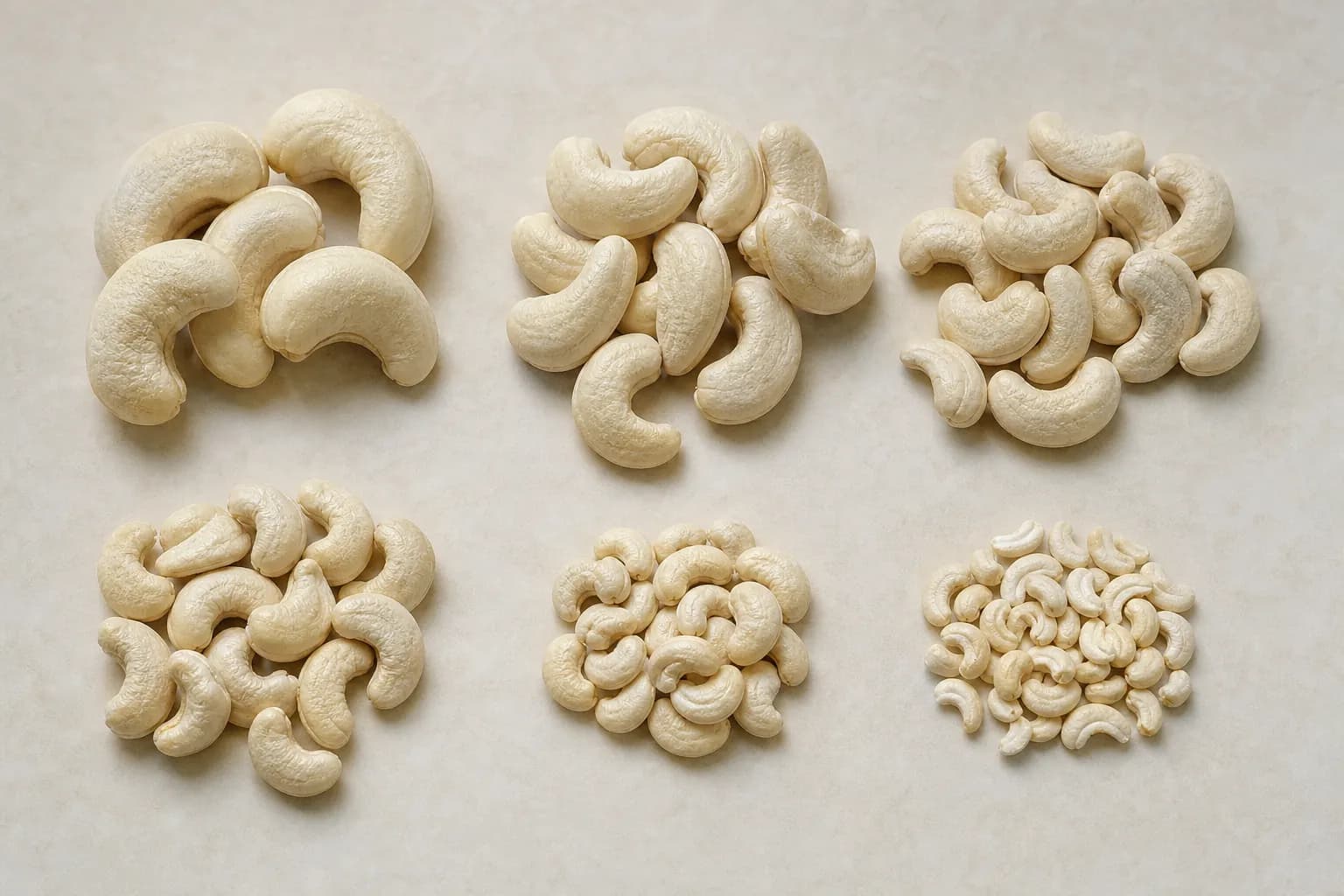
'Premium cashews' is not a grade. The trade runs on a defined vocabulary: white wholes counted per pound (W180, W210, W240, W320, W450), scorched wholes (SW240 and the rest), splits (WS, SS), pieces (LWP, SWP), and raw cashew nuts specified by out-turn and nut count. A quote that avoids it comes either from someone who does not know the product or from someone who wants room to ship something cheaper.
A quote worth comparing carries the grade and form, the count per pound with a tolerance band, maximum moisture, defect tolerances, the packing format, the Incoterm and a validity date. A price with no expiry is not really a quote — cashew prices move with the raw-nut season, and an honest number says when it lapses.
Check 7 — Are the payment terms normal for this trade?
This is where money is actually lost. The trade runs on Letter of Credit at sight or Telegraphic Transfer, most often a deposit at contract — commonly 20 to 30 per cent — with the balance against shipping documents on or after the bill of lading date. A deposit is normal: the exporter buys, processes and packs before a container moves. Paying the full value before anything ships is not. Normal looks like this:
- Letter of Credit at sight, with the required documents defined in the LC text.
- A 20 to 30 per cent deposit at contract, balance against shipping documents.
- Payment to a company account in the registered name, in the country of operation.
- Third-party pre-shipment inspection at the buyer's cost, if you want independent eyes on the loading.
And what is not:
- 100 per cent payment in advance, especially on a first transaction.
- An account in a personal name, or a company name that differs from the contract.
- An account in a country with no connection to the goods or the seller.
- A change of banking details mid-transaction, especially one arriving by email.
- Pressure to pay today because 'another buyer is holding the container'.
Confirm any change of banking details by voice, on a number you already held. Business email compromise is the most common way money disappears in this trade, and it looks exactly like a routine message from a supplier you trust.
Check 8 — Can they list the documents that travel with the shipment?
Ask before you contract, and ask them to list it themselves. An exporter who has actually shipped can recite the set:
- Commercial invoice.
- Packing list, itemised with lot numbers and net weights.
- Certificate of origin.
- Phytosanitary certificate issued by the origin plant-health authority.
- Aflatoxin and quality test reports tied to the shipped lots.
- Bill of lading with full container details.
- Marine insurance certificate, on CIF terms.
Then check the set matches the deal you signed — same lot numbers as the COA, same grade as the contract, same consignee as your paperwork. Someone who hesitates over the phytosanitary certificate, or cannot name the authority that issues it, has probably never exported the product.
Check 9 — Will they get on a call and answer spec questions precisely?
The last check is the least technical and the most revealing. Ask for a video call, and ask specific questions:
- What out-turn are you seeing this season, and how does it compare with last?
- What moisture do you bag at, and how is it measured?
- Which laboratory tests your lots, and how are samples drawn?
- What happens if my counts come in outside tolerance on arrival?
- Which districts did this lot come from, and when was it harvested?
You are not testing whether the answers impress you, but whether they are precise, consistent and volunteered. Someone running the operation answers with numbers; someone reselling a photograph answers with adjectives. References are worth asking for, though many buyers decline for commercial reasons — where they are given, contact them yourself and ask about a real shipment.
What are the red flags that should stop a deposit?
- A price far below market for the named grade, with no explanation.
- Pressure to pay quickly, or a discount that expires in hours.
- No written specification sheet, and reluctance to produce one.
- Refusal to send a sample, or a sample with no lot reference.
- Payment requested to a personal account, or to a name that does not match the contract.
- Certificates supplied as images with no issuer number you can verify.
- Answers that change between conversations — origin, capacity, facility.
- Large claimed volumes with no verifiable presence at origin.
None of these proves fraud on its own. Two or three together, on a first transaction, is reason to slow down — and slowing down costs nothing but time.
“Every honest exporter has been asked these questions, and none of us mind. The ones who bristle at being checked are telling you what the checks would have found.”
- Joachim Mbwana, Sourcing Lead
How do we answer these nine checks ourselves?
It would be strange to publish this list and not stand against it. Afri Exports has sourced and exported cashews from Mtwara, in southern Tanzania, since 2010. Our processing operates under Tanzania Bureau of Standards certification, every export lot is laboratory tested for aflatoxin before despatch with results tied to the shipping documents, and each container traces back to the districts and harvest window it came from. We quote in named grades with counts and tolerances, and we sample before a first container.
So run the list on us. Ask for the certificate, ask which districts the lot came from, ask for a sample against your specification. That is a better basis for a first container than any promise on a website — including this one.
Related reading
Leave a Comment
Your email address will not be published.